Browse

Log in / Register
 Share

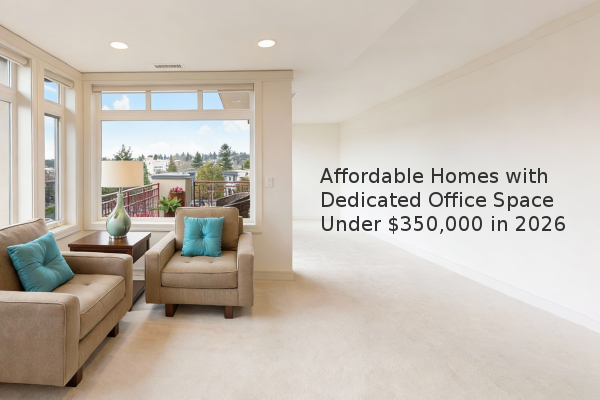
Finding an affordable home with a functional workspace is a top priority for many American households in 2026. With remote work and hybrid learning models becoming permanent for many, the demand for homes that can accommodate professional and educational needs without exceeding the budget is significant. Based on our experience assessment, it is entirely possible to find properties with dedicated offices, flex rooms, or separate living areas below the current median home price of $350,000. This article explores key features to look for and highlights examples of homes across the U.S. that successfully meet this need, providing a practical starting point for your search.
A functional home workspace is more than just a spare room. For a space to be effective for remote work or study, it should offer separation from the main living areas to minimize distractions. Key features include a dedicated room with a door, built-in storage like shelves or desks, and adequate natural light. In more affordable homes, this space might be a flex room—a room without a designated purpose, such as a den or a finished area in a basement—that can be converted into an office. Another valuable feature is an accessory dwelling unit (ADU), a secondary housing unit on the same property that can serve as a completely isolated office.
The following table summarizes the types of workspaces found in affordable homes:
| Feature | Description | Ideal For |
|---|---|---|
| Dedicated Den/Study | A separate room, often with built-in shelving. | Focused, individual work. |
| Finished Basement | Converted lower-level space offering sound separation. | A larger home office or classroom. |
| ADU / Separate Suite | A self-contained unit with its own entrance. | Maximum privacy and zero home-life interference. |
| Multifunctional Flex Room | A room without a fixed purpose (e.g., formal dining room). | A customizable space that can adapt to changing needs. |
When evaluating listings, look for properties that make smart use of their square footage. A well-designed floor plan is often more valuable than a larger, poorly laid-out one. Key elements include split-bedroom designs, where the primary bedroom is separated from other rooms, and open-concept living areas that can be zoned for different activities. Built-in furniture, such as desks and cabinets, can also save space and cost. It's crucial to assess the flow of the home; a layout that allows for clear boundaries between work, learning, and relaxation zones is highly desirable for maintaining a healthy work-life balance.
The following examples, based on real estate market assessments for 2026, illustrate how different properties across the country achieve this balance. All are priced under $350,000, demonstrating that budget constraints do not have to mean sacrificing functionality.
Begin your search by filtering listings specifically for homes with dens, studies, or flex rooms. Be prepared to view properties with imagination, recognizing that a formal dining room or a large landing could be repurposed. During showings, prioritize homes with good sound insulation and natural light in potential workspace areas. Furthermore, consider the long-term resale value; homes with dedicated offices are likely to remain in demand, making them a sound investment.
To successfully find an affordable home with a workspace, focus on properties with flexible floor plans, prioritize functional layout over sheer size, and consider the long-term benefits of a dedicated office area for both your current needs and future resale value.